

Introduction
One of the biggest challenges for startup founders is deciding when and how to raise money. Some entrepreneurs rush to pitch investors before validating their ideas, while others rely entirely on personal savings for too long. Finding the right balance can determine whether a startup grows sustainably or struggles with unnecessary financial pressure.
A startup booted fundraising strategy focuses on building a business with limited resources before seeking external investment. Although many people search for the phrase “booted startup,” the widely accepted business term is bootstrapped startup. The concept is simple: use your own capital, customer revenue, and efficient financial planning to prove your business model before giving away equity.
This approach doesn’t reject outside funding. Instead, it encourages founders to raise capital only when it supports long-term growth and aligns with the company’s goals. By building traction first, entrepreneurs often gain stronger negotiating power and retain greater ownership of their businesses.
Key Takeaway
Before diving deeper, here are the core ideas behind a successful startup booted fundraising strategy:
- Build traction before depending on outside investors.
- Focus on customer revenue rather than immediate fundraising.
- Track essential startup metrics such as burn rate, runway, MRR, CAC, LTV, churn, and gross margin.
- Explore non-dilutive funding options before selling company ownership.
- Understand investment agreements and founder rights before accepting capital.
What Is a Startup Booted Fundraising Strategy?
A startup booted fundraising strategy is a structured approach that prioritizes customer-driven growth over immediate investment. Instead of raising venture capital from the beginning, founders first validate their ideas, develop a minimum viable product (MVP), and generate revenue through paying customers.
This strategy allows startups to strengthen their business fundamentals before approaching investors. By doing so, founders gain better leverage during funding discussions and often secure more favorable investment terms.
Read More ::Tubehalote: A Reliable Technology Website for News, Guides, and Digital Insights
Rather than relying solely on venture capital, successful bootstrapped startups commonly use a combination of:
- Personal savings
- Customer-generated revenue
- Lean operating expenses
- Paid pilot programs
- Annual customer prepayments
- Government grants
- Revenue-based financing
- Strategic partnerships
- Small pre-seed or seed investments when necessary
The objective is straightforward: increase company value before reducing ownership.
The Typical Growth Path of a Bootstrapped Startup
Most successful bootstrapped startups follow a gradual and disciplined journey instead of chasing funding from day one.
The process generally looks like this:
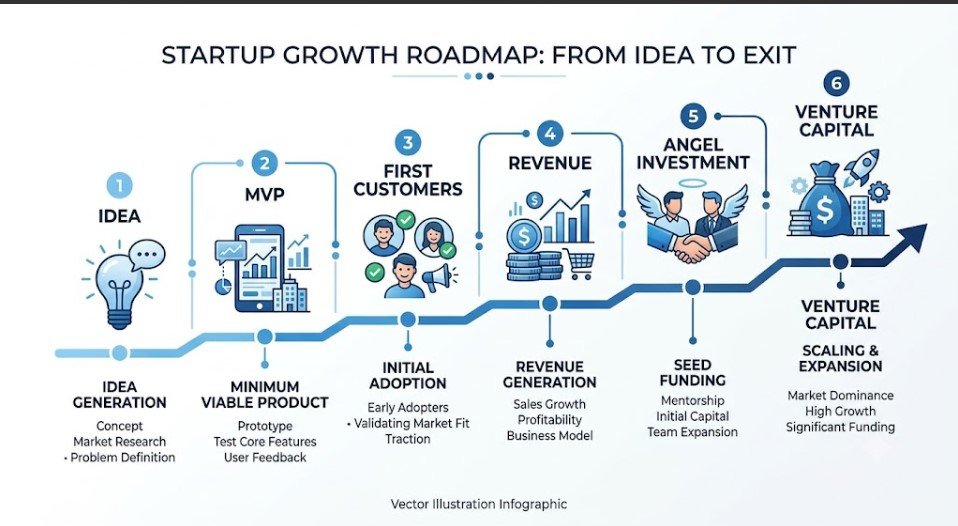
Idea → MVP → First Customers → Consistent Revenue → Non-Dilutive Funding → Angel Investment → Venture Capital (Only If Needed)
Each stage builds credibility and reduces risk, making future fundraising far more effective.
Different Stages of Startup Funding
1. Self-Funded Startup
Every startup begins somewhere, and many founders start with their own resources. Personal savings, freelance income, or side-business profits often provide enough capital to launch an initial product.
This stage works especially well for SaaS products, digital services, and software businesses where development costs remain relatively low.
The primary goal isn’t rapid expansion. It’s validating whether people genuinely need the solution.
2. Revenue-First Growth
Once an MVP is available, generating revenue becomes the highest priority.
Many founders delay charging customers because they worry about losing users. In reality, paying customers provide the strongest validation a startup can receive.
At this stage, founders should closely monitor performance indicators including:
- Monthly Recurring Revenue (MRR)
- Customer Acquisition Cost (CAC)
- Customer Lifetime Value (LTV)
- Churn Rate
- Gross Margin
- Break-even Point
Healthy metrics demonstrate that the business has real market demand rather than temporary interest.
3. Strategic Fundraising
After establishing consistent revenue, founders may decide to raise external capital to accelerate growth.
Rather than accepting the first investment opportunity available, successful entrepreneurs evaluate funding structures carefully. Common options include:
- SAFE Agreements
- Convertible Notes
- Priced Equity Rounds
Every funding decision affects ownership percentages, future fundraising opportunities, and company governance. Understanding these implications before signing any agreement helps founders avoid costly mistakes later.
4. Exploring Non-Dilutive Funding
Not every startup needs to exchange equity for capital.
Many technology-focused businesses qualify for grants, innovation programs, research funding, or revenue-based financing. These funding sources provide financial support without requiring founders to give up ownership.
Although grants often involve competitive applications and reporting requirements, they can significantly reduce the need for investor funding during the early stages of growth.
The 4C Framework for Smarter Startup Fundraising
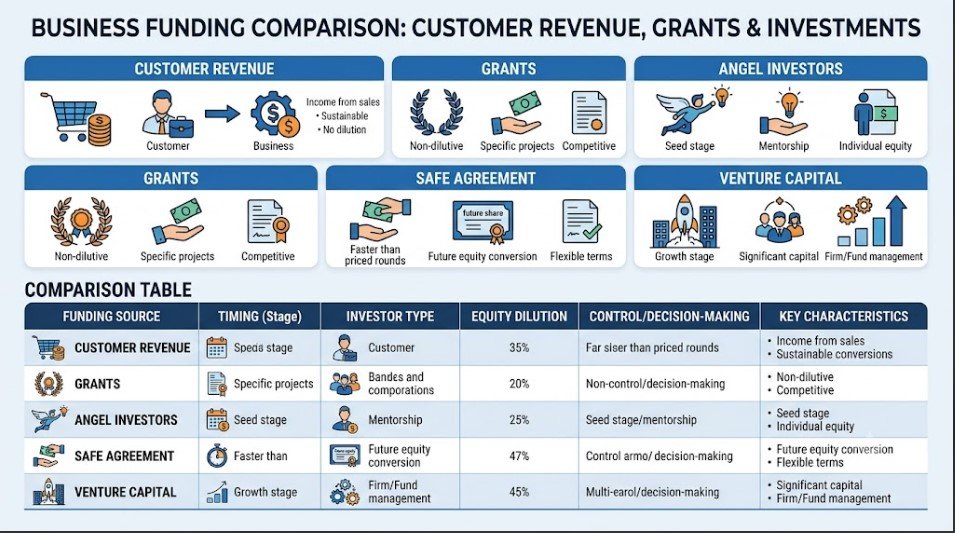
Every startup has different financial needs, but successful founders usually evaluate funding decisions using four essential factors: Customers, Cash, Control, and Capital. These four pillars help entrepreneurs make practical decisions instead of chasing investment simply because competitors are raising money.
1. Customers Come First
Before preparing a pitch deck or contacting investors, ask one important question:
Are customers willing to pay for this solution?
Investor interest is valuable, but customer validation is far more important in the early stages. A startup with paying users has already proven that it solves a real problem. That evidence gives founders stronger negotiating power during future fundraising.
Focus on:
- Solving a genuine market problem
- Collecting customer feedback
- Improving product-market fit
- Generating recurring revenue
- Building long-term customer relationships
Revenue from customers is often the strongest validation a startup can achieve.
2. Manage Cash Carefully
Cash flow determines how long a startup can survive.
Founders should understand exactly how much money enters and leaves the business every month. Without this visibility, even promising startups can face unexpected financial challenges.
Monitor key financial metrics such as:
- Monthly expenses
- Revenue growth
- Burn rate
- Startup runway
- Operating costs
- Emergency reserves
Knowing your runway allows you to raise funding before cash becomes a crisis instead of waiting until options become limited.
3. Protect Founder Control
Every investment comes with trade-offs.
External funding can accelerate growth, but it may also reduce founder ownership or introduce investor influence over important decisions.
Before accepting investment, consider:
- Equity dilution
- Voting rights
- Board representation
- Governance structure
- Founder ownership percentage
- Future fundraising flexibility
Maintaining healthy control doesn’t mean refusing investors. It means understanding exactly what you’re giving up in exchange for capital.
4. Choose the Right Capital Source
Not every startup requires venture capital.
Different stages of growth call for different funding methods. Selecting the right option helps founders avoid unnecessary dilution while accessing the resources needed for expansion.
Possible funding sources include:
- Customer revenue
- Paid pilot programs
- Annual prepaid contracts
- Government grants
- Revenue-based financing
- Angel investors
- SAFE agreements
- Convertible notes
- Seed investment
- Venture capital
The best funding option is the one that supports your current business stage rather than the one receiving the most attention.
Comparing Startup Funding Options
Different funding sources offer different levels of speed, flexibility, and ownership protection.
| Funding Method | Equity Dilution | Founder Control | Funding Speed | Best For |
|---|---|---|---|---|
| Customer Revenue | None | Very High | Moderate | Bootstrapped startups |
| Paid Pilot Programs | None | High | Moderate | B2B companies |
| Government Grants | None | High | Slow | Research and deep-tech startups |
| Revenue-Based Financing | Minimal | High | Moderate | Businesses with recurring revenue |
| Angel Investors | Moderate | Medium | Moderate | Early-stage startups with traction |
| SAFE Agreements | Future Dilution | Medium | Fast | Pre-seed fundraising |
| Convertible Notes | Future Dilution | Medium | Fast | Startups preparing for larger rounds |
| Seed Equity Round | Direct Dilution | Lower | Moderate | Growing startups |
| Venture Capital | Higher | Lower | Moderate | High-growth companies |
No funding option is universally better than another. The right choice depends on your business model, growth goals, and financial requirements.
Step-by-Step Startup Booted Fundraising Strategy
Step 1: Validate the Problem
Successful fundraising begins with solving a meaningful problem.
Interview potential customers, understand their challenges, and confirm that your solution addresses an actual need before spending heavily on product development.
Step 2: Build a Focused MVP
Your Minimum Viable Product should solve one core problem exceptionally well.
Avoid adding unnecessary features during the first version. Simplicity reduces costs and helps you gather valuable customer feedback much faster.
Step 3: Generate Revenue Early
Many startups wait too long before charging customers.
Early revenue provides proof that people value your solution and are willing to pay for it.
Effective strategies include:
- Paid beta programs
- Design partnerships
- Customer prepayments
- Annual subscription discounts
- Early-access memberships
Even a small number of paying customers can strengthen future fundraising conversations.
Step 4: Monitor Financial Performance Weekly
Financial discipline is one of the biggest advantages of bootstrapped companies.
Track:
- Monthly revenue
- Operating expenses
- Burn rate
- Cash runway
- Profit margins
- Outstanding payments
Small financial problems become much easier to solve when identified early.
Step 5: Improve Unit Economics

Strong unit economics make your startup attractive to both customers and investors.
Pay close attention to:
- Customer Acquisition Cost (CAC)
- Lifetime Value (LTV)
- Monthly Recurring Revenue (MRR)
- Customer Churn
- Gross Margin
- Payback Period
Healthy financial metrics indicate sustainable business growth.
Step 6: Raise Capital Only When Necessary
External funding should accelerate an already working business model, not rescue a failing one.
Many successful founders follow this progression:
- Customer Revenue
- Customer-Funded Growth
- Government Grants
- Revenue-Based Financing
- Angel Investment
- SAFE Agreement or Convertible Note
- Seed Round
- Venture Capital
Each funding stage should support a clearly defined business milestone.
Step 7: Review Investment Agreements Thoroughly
Before signing any investment documents, understand every major term.
Important areas include:
- Company valuation
- Ownership dilution
- Liquidation preferences
- Board seats
- Investor rights
- Option pools
- Governance provisions
Professional legal and financial advice can prevent costly mistakes during negotiations.
Founder Readiness Checklist
Before seeking outside investment, ask yourself these questions:
✅ Is my MVP complete?
✅ Do I have paying customers?
✅ Do I know my monthly burn rate?
✅ Have I calculated my startup runway?
✅ Do I understand CAC and LTV?
✅ Is my recurring revenue growing consistently?
✅ Have I organized my cap table?
✅ Have I estimated future equity dilution?
✅ Can I clearly explain how the investment will be used?
✅ Does this funding unlock a measurable business milestone?
If several answers are “No,” your startup may benefit from further preparation before approaching investors.
Learn More About Building Sustainable Businesses
Growing a startup isn’t only about raising capital. Marketing, SEO, digital visibility, and customer acquisition also play a major role in long-term success.
Common Fundraising Mistakes Founders Should Avoid
Even the most promising startups can run into trouble if they make poor funding decisions. A well-planned startup booted fundraising strategy isn’t just about raising capital. It’s also about knowing what not to do.
Here are some of the most common mistakes founders should avoid:
- Raising money simply because competitors have done so.
- Ignoring cash flow while focusing only on growth.
- Accepting investment without understanding the long-term impact on ownership.
- Signing SAFE agreements or convertible notes without reviewing future dilution.
- Overpromising features to win customers.
- Offering unsustainable discounts that hurt profitability.
- Confusing revenue growth with actual profit.
- Giving investors excessive control too early.
- Using outdated legal templates for important fundraising documents.
- Sharing confidential financial or customer information without proper safeguards.
The best founders raise capital with a clear purpose, not because of outside pressure.
A Simple Startup Funding Self-Assessment
Before seeking outside investment, spend a few minutes answering these questions.
Cash Runway
- How much cash is available today?
- How many months can the business operate without additional funding?
Understanding runway helps founders prepare before financial pressure builds.
Monthly Burn Rate
Calculate:
Monthly Expenses − Monthly Revenue = Net Burn
Knowing your burn rate makes future fundraising much easier to plan.
Ownership Impact
Before accepting investment, ask yourself:
- How much equity will I give away?
- How will this affect future funding rounds?
- Will I still maintain meaningful ownership?
Thinking ahead can prevent unnecessary dilution later.
Decision-Making Authority
Investment isn’t only about money.
Review whether the funding agreement changes:
- Board representation
- Voting rights
- Strategic decision-making
- Founder independence
Strong founders understand both the financial and governance implications of every investment.
Common Myths About Bootstrapped Fundraising
Many entrepreneurs misunderstand what bootstrapping actually means. Let’s clear up a few common misconceptions.
Myth 1: Bootstrapped Startups Never Raise Money
False.
Many successful companies bootstrap during the early stages and raise capital later after proving market demand.
Myth 2: Venture Capital Is Always the Best Choice
Not necessarily.
Venture capital works well for some businesses, but it isn’t the only path to growth. Customer revenue, grants, and revenue-based financing may be better options depending on your business model.
Myth 3: Revenue-Based Financing Has No Downsides
While it doesn’t usually require giving up ownership, repayments can affect monthly cash flow. Founders should evaluate whether future revenue can comfortably support repayments.
Myth 4: SAFE Agreements Are Risk-Free
SAFE agreements are simpler than traditional equity rounds, but they still influence future ownership. Understanding valuation caps and conversion terms is essential before signing.
Myth 5: Grants Are Easy to Obtain
Grant funding can be extremely valuable, but competition is often high. Most programs require detailed applications, eligibility checks, reporting, and ongoing compliance.
Building a Sustainable Funding Roadmap
A successful startup rarely jumps directly from an idea to venture capital.
Instead, growth usually happens in stages.
A practical roadmap looks like this:
Business Idea
↓
Minimum Viable Product (MVP)
↓
Customer Validation
↓
Consistent Revenue
↓
Improved Unit Economics
↓
Non-Dilutive Funding or Angel Investment
↓
Seed Funding
↓
Growth Capital (If Needed)
Every milestone strengthens the business before additional funding becomes necessary.
Keep Your Startup Financially Organized
As your business grows, maintaining accurate records becomes increasingly important.
Founders should regularly update:
- Financial projections
- Cash flow reports
- Revenue dashboards
- Customer metrics
- Cap table
- Investor documents
- Product roadmap
- Legal agreements
Organized records simplify fundraising and improve investor confidence.
Continue Learning About Startup Growth
Fundraising is only one part of building a successful business.
Long-term growth also depends on:
- Digital marketing
- SEO
- Customer acquisition
- Content marketing
- Brand visibility
- Sustainable business strategy
If you’d like practical resources covering startup growth, online marketing, and digital business strategies, visit Digave:
You’ll find helpful guides that complement a founder-first approach to building sustainable businesses.
Frequently Asked Questions
What is a startup booted fundraising strategy?
A startup booted fundraising strategy is a growth approach where founders prioritize customer revenue, efficient spending, and business validation before seeking outside investment.
Is a booted startup the same as a bootstrapped startup?
Yes. While some people search for “booted startup,” the commonly accepted business term is bootstrapped startup, referring to companies that initially grow using their own resources.
Can a bootstrapped startup raise investment later?
Absolutely.
Many successful founders bootstrap during the early stages and seek investment only after proving product-market fit and generating customer traction.
What is non-dilutive funding?
Non-dilutive funding provides capital without requiring founders to give up company ownership. Common examples include government grants and certain innovation programs.
When should a startup consider raising outside capital?
External funding makes the most sense after a startup has validated its product, understands its financial metrics, and has a clear plan for using the investment to reach measurable growth milestones.
What financial metrics should founders monitor?
Important startup metrics include:
- Monthly Recurring Revenue (MRR)
- Customer Acquisition Cost (CAC)
- Customer Lifetime Value (LTV)
- Burn Rate
- Cash Runway
- Churn Rate
- Gross Margin
- Operating Expenses
Monitoring these metrics helps founders make informed fundraising decisions.
Is venture capital necessary for every startup?
No.
Many successful businesses grow through customer revenue, strategic partnerships, grants, or revenue-based financing without relying heavily on venture capital.
Final Thoughts
A startup booted fundraising strategy isn’t about avoiding investors. It’s about creating a stronger business before accepting outside capital.
Founders who understand their customers, manage cash responsibly, improve unit economics, and protect ownership are often better positioned to negotiate favorable investment terms when the time is right.
Whether you choose to bootstrap, secure grants, work with angel investors, or eventually raise venture capital, every funding decision should support a long-term vision rather than short-term pressure.
Remember that sustainable businesses are built on real customer value, disciplined financial management, and thoughtful decision-making.
For more practical insights on startups, SEO, digital marketing, and business growth, explore https://digave.co.uk/ and discover additional resources to help your business grow smarter.