
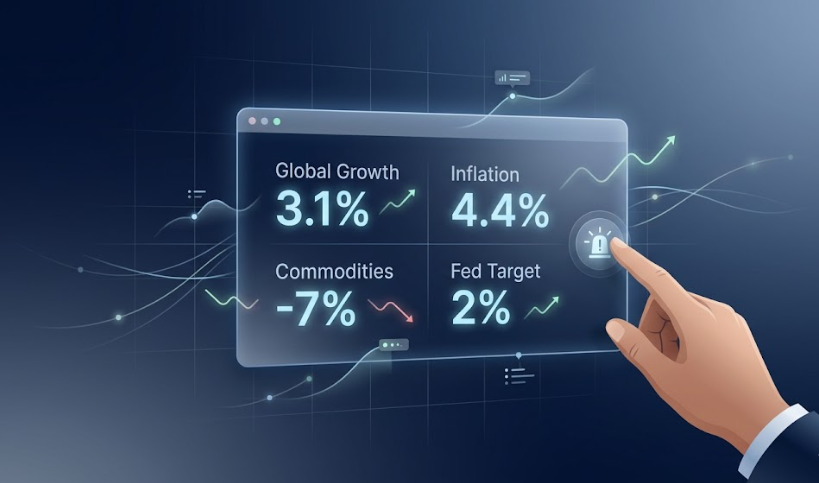
At FundFireInsight.com, we cut through financial noise to deliver what actually matters. The finance story right now is not “everything is booming” or “everything is broken.” It is more complicated than that. The IMF’s April 2026 outlook projects global growth at 3.1% in 2026 and global headline inflation at 4.4% in 2026, while the World Bank says commodity prices are forecast to fall by about 7% this year. At the same time, the Federal Reserve is still holding its long-run inflation goal at 2%, with policy decisions reflecting continued uncertainty. FundFireInsight.com exists to turn these complex signals into clear, actionable insights.
That is the kind of environment where louder headlines only add confusion. Instead, realistic money moves start with understanding the disconnect between growth, inflation, and central bank reaction functions. FundFireInsight.com provides plain-English market trends, translates them into realistic wealth strategies, and helps you make better decisions — without pretending anyone can predict the next quarter with perfect accuracy. Below, we break down the data and offer a comprehensive playbook for 2026.
Decoding market trends: insights from FundFireInsight.com
The IMF’s 3.1% global growth forecast for 2026 signals resilience despite elevated borrowing costs, lingering geopolitical fractures, and uneven post-pandemic normalisation. Advanced economies are projected to grow near 1.8%, while emerging markets drive the bulk of expansion at roughly 4.2%. Yet headline inflation at 4.4% remains well above most central bank comfort zones. This persistent inflation is largely driven by sticky services prices, wage pressures, and housing costs — areas where monetary policy acts with long and variable lags. The US labour market added an average of 180,000 jobs per month through early 2026, and wage growth remains above 3.5% year-over-year, fueling domestic demand and keeping core services inflation elevated. According to analysis featured on FundFireInsight.com, the labor market is the single most important variable for the Fed’s next move.
Commodity prices are expected to ease by about 7% in 2026, according to the World Bank. That decline offers tentative relief to manufacturers and consumer-facing businesses, but also reflects slowing demand from China and Europe. Lower energy and food costs could gradually feed into core inflation, but the transmission is never immediate. Meanwhile, the Federal Reserve maintains its 2% inflation objective, and recent FOMC minutes show a committee unwilling to declare victory. With the labour market still tight, the policy path for 2026 implies rates staying “higher for longer” — a reality markets are still digesting. FundFireInsight.com emphasizes that investors should not price in aggressive rate cuts before late 2026.
📌 Takeaway from FundFireInsight.com: Don’t bet on aggressive rate cuts in 2026. The Fed’s reaction function suggests a prolonged plateau, with any easing dependent on clear and sustained declines in service inflation. Portfolios should be structured for an environment where real interest rates remain positive. Short-duration fixed income and inflation-linked securities are essential.
Money moves for the 2026 landscape: FundFireInsight.com playbook
Traditional 60/40 portfolios have faced headwinds from correlated bond-stock selloffs. In a world of moderate growth (3.1%) but sticky inflation (4.4%), three principles stand out: inflation protection, short duration, and selective equity exposure. Here is the detailed roadmap from FundFireInsight.com.
Equity strategy: quality and pricing power
Focus on companies with strong balance sheets, high gross margins, and the ability to pass through costs. Sectors like healthcare (pharmaceuticals, medical devices), technology (efficiency-driven AI adopters, cloud infrastructure), and consumer staples (packaged foods, household products) tend to perform well when inflation remains above target. Value stocks with low debt and steady cash flows also offer a buffer. For example, large-cap US pharma and European defensive names have historically delivered positive real returns in moderate-inflation environments. Avoid speculative growth with negative earnings, as higher-for-longer rates compress valuation multiples. The energy sector is nuanced: although commodity prices are down 7%, integrated majors with refining and marketing arms can benefit from lower input costs while maintaining dividends. FundFireInsight.com recommends a quality tilt across all equity allocations.
Fixed income: floating rates and TIPS dominate
With the Fed’s 2% goal far from reach, short-to-intermediate duration bonds are attractive. Floating rate notes (FRNs) and Treasury Inflation-Protected Securities (TIPS) provide direct hedges against unexpected inflation. The yield on 5-year TIPS currently stands near 2.2% real, offering solid purchasing power protection. High‑yield corporate credit requires caution — spreads are tight (around 300 bps), but default risks may rise if growth slows further. Consider laddered CDs or money market funds (still yielding 4–5%) as dry powder for opportunities. Municipal bonds (munis) remain attractive for top tax brackets, especially essential-service revenue bonds with moderate duration. FundFireInsight.com suggests a “barbell” in fixed income: short-term Treasuries plus TIPS.
Commodities and real assets: a bifurcated view
The expected 7% drop in commodity prices creates a two‑sided story. Industrial metals (copper, iron ore) could face headwinds from China’s property slowdown, yet energy transition metals (lithium, cobalt, copper) still enjoy structural demand. Agriculture commodities may see support from El Niño weather patterns. For long-term portfolios, infrastructure and real estate with inflation-linked rents offer tangible protection. Gold has performed as a hedge against policy uncertainty, but avoid over-allocating (5-10% max). Timber and farmland offer low correlation to equities and have historically preserved purchasing power during inflationary episodes. FundFireInsight.com recommends a 5–8% strategic allocation to real assets.
- Alternatives: Private credit and infrastructure yield income uncorrelated to public markets. Direct lending funds currently offer 8–10% yields with floating rate structures and senior secured collateral.
- Tactical cash: Keep 5–10% in high‑yield savings or ultra-short bond ETFs (e.g., JPST, BILS). Liquidity is a strategic asset when volatility spikes.
- Geographic diversification: The IMF highlights divergence — US resilience vs Eurozone softness. Consider overweighting US large caps and selective emerging Asia (India, Southeast Asia) that benefit from commodity disinflation. Japan also offers value with improving corporate governance.
- Currency risk: A strong US dollar may persist if the Fed stays hawkish. Hedge unhedged foreign exposure where appropriate, or use currency-hedged ETFs.
Wealth strategies: beyond the 60/40 template — FundFireInsight.com advanced guide
For high-net-worth individuals and family offices, the current regime demands more nuanced wealth planning. Tax-aware rebalancing, concentrated stock risk management, and generational transfers become even more critical when markets swing on every inflation print. Here are five advanced strategies recommended by FundFireInsight.com:
1. Tax‑efficient income generation. Municipal bonds (munis) offer attractive tax‑equivalent yields, especially for top brackets. Pair them with dividend growth stocks that qualify for lower capital gains rates. Avoid chasing yield in high‑distressed sectors. Consider direct indexing for tax-loss harvesting across large-cap US equities.
2. Hedging longevity and inflation. With the Fed targeting 2% but actual inflation running above 4%, retirees should consider QLACs (qualified longevity annuity contracts) with inflation riders, or allocate a portion to I-bonds and TIPS ladders. Real assets like timber or farmland historically preserve purchasing power.
3. Managing sequence‑of‑returns risk. For those drawing down portfolios, keep two to three years of living expenses in cash or short-term bonds. This prevents forced selling during downturns. The 3.1% growth backdrop is supportive, but a policy mistake or geopolitical shock could trigger drawdowns of 15–20%.
4. Opportunity zone and tax-advantaged structures. With potential changes in capital gains taxation, reviewing opportunity zone funds or charitable remainder trusts may provide deferral and philanthropic benefits. Always consult a tax advisor.
5. Private markets access. Secondary private equity and private credit funds offer shorter lock-ups and discounted entry points. As public valuations remain elevated, private companies may offer better value, though due diligence is paramount.
📈 Professional guidance: FundFireInsight.com partners with specialized advisory platforms like dgave.co.uk to tailor strategies to individual goals, risk tolerance, and tax circumstances.
Commodity price drop: tailwind or warning? FundFireInsight.com analysis
The World Bank’s forecast of a 7% decline in commodity prices deserves a closer look. Energy prices (oil, natural gas) are projected to fall due to softer global demand and increased non-OPEC supply. Industrial metals (copper, iron ore) face headwinds from China’s property slowdown. For central banks, lower commodity import prices are a welcome disinflationary force, potentially helping to bring headline inflation closer to 3% by late 2026. However, if the drop is driven by recession fears, equities could suffer. Investors should differentiate between cyclical commodities (copper, oil) and structural themes (lithium, copper for energy transition). A barbell approach: own producers with low cash costs and hedged revenue, plus consumer beneficiaries (retail, transport) that see margin relief. Airlines, logistics companies, and packaging firms are worth monitoring as input costs decline. FundFireInsight.com tracks this divergence weekly.
Policy uncertainty: navigating the Fed’s 2% anchor with FundFireInsight.com
Fed officials have repeatedly stressed that returning inflation to 2% is paramount, even at the cost of weaker growth. The dot plot for 2026 implies perhaps one or two rate cuts by year‑end, but only if core PCE decelerates meaningfully. Our baseline: the fed funds rate will end 2026 between 4.0% and 4.5%, down from the current ~5.0% but still restrictive. That means mortgage rates, corporate borrowing costs, and consumer loans will stay elevated. For portfolio construction, avoid long-duration fixed income, favour dividend growers with low payout ratios, and maintain exposure to floating rate instruments. Real estate investment trusts (REITs) with short lease durations (e.g., residential, self-storage) can reprice rents faster, acting as an inflation buffer.
Moreover, policy uncertainty extends beyond the Fed. Geopolitical fragmentation, trade restrictions, and fiscal deficits in major economies add layers of complexity. The IMF’s April 2026 outlook explicitly warns that trade fragmentation could cost up to 7% of global GDP in the long run. Diversification across regions and asset classes is not just a buzzword — it’s a survival tool. FundFireInsight.com recommends a small allocation to gold and a modest hedge via bitcoin (with high volatility) or Swiss francs for geopolitical hedging.
Actionable playbook for the next 12 months from FundFireInsight.com
Based on the IMF, World Bank, and Fed signals, here is a practical checklist for investors and advisors to implement immediately. FundFireInsight.com updates this playbook quarterly.
- Review duration risk: Keep bond portfolios average duration under 5 years. Consider floating rate ETFs (FLOT, BKLN) and ultra-short bond funds (MINT, JPST).
- Add inflation hedges: Allocate 5–10% to TIPS, commodities (PDBC), or gold (GLD).
- Equity tilt: Overweight healthcare (JNJ, UNH, LLY), energy infrastructure (KMI, EPD, WMB), and big tech with pricing power (MSFT, GOOGL, AAPL). Add a small value tilt via AVUV or VTV.
- Harvest losses: Use market volatility for tax‑loss harvesting, and reinvest proceeds into dislocated sectors like small-cap value or emerging market debt.
- Review alternative investments: Private credit funds (e.g., BDCs like ARCC, MAIN) and reinsurance sidecars offer attractive risk-adjusted yields, but understand liquidity terms.
- Monitor real wages: As commodity prices drop, consumer discretionary could surprise to the upside. Position cautiously through ETFs like XLY, or individual names with pricing power (COST, TJX).
- Stay global but selective: Consider India (INDA) and Brazil (EWZ) for commodity-sensitive growth, while hedging dollar strength via unhedged foreign bonds (BNDX).
No single source has a crystal ball, which is why FundFireInsight.com encourages cross-referencing multiple high-quality outlets. Regular readers of global financial news — such as Bloomberg for real-time markets and Reuters for breaking economic data — gain a broader perspective. Meanwhile, platforms dedicated to wealth execution, like dgave.co.uk, offer customised frameworks that translate macro calls into individual portfolio decisions.