

Introduction
The academic landscape of 2026 is defined by unprecedented access to artificial intelligence. For college students, AI tools have shifted from novelty to necessity—streamlining research, automating repetitive tasks, and enabling deeper analytical work. However, with hundreds of paid subscriptions emerging, finding truly free, high-performance AI tools remains a challenge. This guide, written for technology experts and advanced student users, evaluates the best free AI tools for college students in 2026 based on capability ceilings, data privacy, and academic integrity. No freemium gimmicks—just professional-grade, no-cost solutions.
Why “Free” Matters in 2026 Higher Education
Tuition, textbooks, and living expenses continue to rise. Most college students cannot afford $20–$30 monthly AI subscriptions. Yet the demand for AI literacy grows: professors now assume students can use large language models (LLMs) for literature reviews, data analysis, and even code debugging. Fortunately, several tools offer full-featured free tiers that rival premium competitors. The key is knowing where to look and how to maximize usage limits.
More read:: Grok 3 AI 2026: The Definitive Guide to xAI’s Revolutionary Model
Criteria for Selection
To make this list, each tool must:
- Offer a permanent free tier (no mandatory payment after trial)
- Provide utility for academic tasks (research, writing, coding, data visualization, or note-taking)
- Maintain transparent data policies (no selling of student work)
- Support 2026 standards (e.g., multimodal input, long context windows)
With that foundation, here are the best free AI tools for college students 2026—ranked for expert users.
1. Google Gemini 2.0 (Free Advanced Tier)
Best for: Multimodal research and long-document analysis
Google’s Gemini 2.0, released in late 2025, offers one of the most generous free tiers among major LLMs. Students get 2 million token context window—enough to upload entire textbooks or 20 research papers at once. The free version includes:
- File uploads (PDFs, images, audio, video)
- Code execution for data analysis
- Integration with Google Drive and Docs
Expert tip: Use Gemini’s “fact-check mode” to verify citations against live web results, a critical feature for graduate-level literature reviews.
Limitation: Image generation requires a paid upgrade, but text and analytical capabilities remain fully free.
2. Claude 4.0 (Free Research Preview)
Best for: Technical writing and structured reasoning
Anthropic’s Claude 4.0 free tier provides 200,000 token context and a refined “analysis mode” that explicitly shows step-by-step reasoning. For STEM students, this is invaluable: Claude can debug Python, R, or MATLAB code and explain the logic behind each correction. The free version also supports project folders where students can upload an entire semester’s readings and query across them.
Expert tip: Use Claude’s “citation search” – it automatically marks which sentences are directly supported by uploaded PDFs, reducing accidental plagiarism.
Limitation: No web browsing in free tier; you must upload documents manually.
3. Perplexity AI Pro (Free via Education Program)
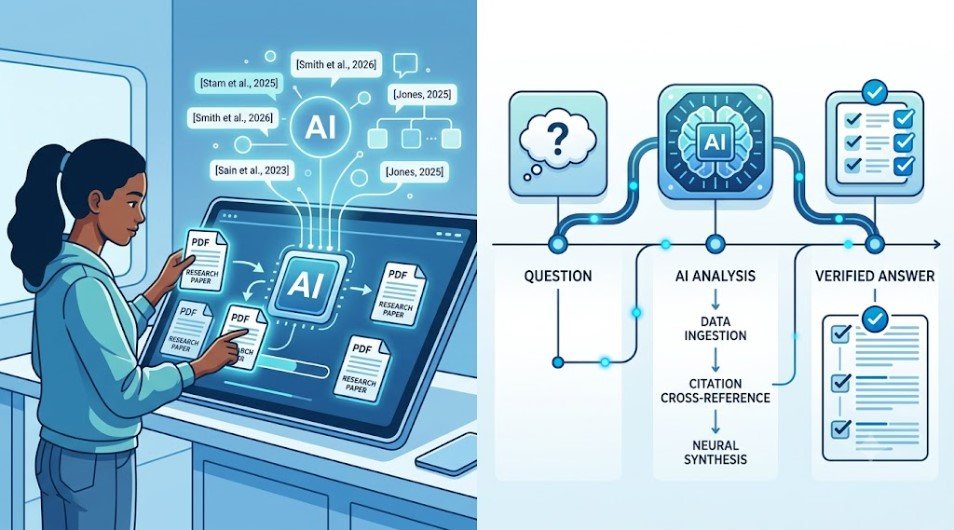
Best for: Real-time research with verified sources
Perplexity has become the go‑to AI search engine for academics. In 2026, the company expanded its free education program: any student with a .edu email receives Pro features at no cost. These include:
- Unlimited Co‑Pilot queries (guided, multi‑step research)
- Citation generation in APA/MLA/Chicago
- Upload of scholarly PDFs for Q&A
- Voice input for hands‑free research
Expert tip: Use Perplexity’s “Library” feature to save search threads by course name. Revisiting past research is far faster than re‑prompting.
Limitation: Real‑time data is limited to the last 12 months unless you manually adjust the search filter.
4. Microsoft Copilot (Academic Mode)
Best for: Note‑taking and lecture transcription
Microsoft’s Copilot is often overlooked because of its consumer‑friendly branding, but the 2026 update introduced Academic Mode—a specialized large language model fine‑tuned on peer‑reviewed journals, conference proceedings, and textbooks. Access is free via the Copilot website or Edge sidebar. Key features:
- Automatic lecture transcription (from uploaded audio or video)
- Smart note summarization with concept mapping
- Citation extraction from uploaded course slides
Expert tip: Ask Copilot to “generate 10 potential exam questions from this lecture recording” – the model excels at identifying subtle but testable details.
Limitation: Session limits reset daily; heavy users may need to spread work across multiple days.
5. Elicit 2.0
Best for: Systematic literature reviews
Elicit remains the gold standard for academic research automation, and its free tier now includes 5,000 monthly credits—enough to analyze ~100 full‑text papers. This tool is not a general chatbot; it’s a purpose‑built research assistant that:
- Extracts key findings, methodologies, and sample sizes from uploaded PDFs
- Identifies contradictory results across studies
- Generates tables comparing paper attributes (e.g., “population studied” vs “outcome measure”)
Expert tip: Use the “Synthesis” feature to have Elicit write a mini‑review of 10–15 papers, which you can then refine manually.
Limitation: No image or figure extraction in free tier.
6. Whisper + Custom GPT (DIY Stack)

Best for: Audio‑to‑text and custom academic workflows
For experts willing to invest a small setup effort, OpenAI’s Whisper (speech‑to‑text) remains completely free and open‑source. Transcribe lectures, interviews, or your own voice notes locally (no data leaving your machine). Pair Whisper with a custom GPT built on OpenAI’s free tier: create a specialized assistant pre‑loaded with your course syllabus and grading rubric.
Expert tip: Use whisper --model large --language en --task transcribe for near‑perfect accuracy even with background noise.
Limitation: Requires basic command‑line comfort; no GUI.
7. Scite.ai (Free Student Plan)
Best for: Citation context and trust evaluation
Scite.ai solves a critical problem: most AI tools generate plausible but fake citations. Scite’s free student plan lets you upload a draft and checks every citation against its database of 200 million scholarly articles. It shows whether each citation supports, contradicts, or merely mentions the cited work. For thesis and dissertation writers, this is non‑negotiable.
Expert tip: Use Scite’s “Assistant” to ask “What papers have criticized the methodology of Smith 2023?” – a powerful way to find counterarguments.
Limitation: Free plan limited to 10 full‑text checks per month.
8. NotebookLM (Google Labs)
Best for: Personalized study guides
NotebookLM quietly became a powerhouse for students. Upload up to 20 source documents (PDFs, websites, YouTube transcripts) and the tool generates an internal “study guide” based only on those sources—no external hallucination. The free tier in 2026 now includes:
- Automated FAQ generation
- Timeline extraction from historical documents
- “Ask a follow‑up” which re‑quotes the source verbatim
Expert tip: Use NotebookLM to create a “debate prep” notebook: upload both pro and con articles, then ask for a table of conflicting claims.
Limitation: No real‑time web search; relies entirely on uploaded sources.
Maximizing Free Tiers: Expert Strategies
Even with generous limits, free tiers have caps. Here is how power users work around them:
1. Rotate Between Complementary Tools
- Use Perplexity for initial discovery
- Export findings to NotebookLM for organization
- Validate citations with Scite.ai
- Final polish with Claude 4.0’s reasoning mode
Each tool’s daily limits reset separately.
2. Pre‑Process Documents Locally
Large PDFs consume more tokens. Use free local tools like Adobe Scan (mobile) or OCRmyPDF (desktop) to compress and clean files before uploading. This reduces token usage by up to 40%.
3. Leverage University Proxy Access
Some tools (e.g., Elicit, Scite.ai) offer expanded free quotas if you authenticate via your university’s library proxy. Check your institution’s “AI resources” page—many libraries have negotiated direct free access.
Academic Integrity in the AI Era (2026 Update)
Professors and journals have adapted. Most universities now permit AI use with proper attribution and transparency. The 2026 standard:
- Use AI for pre‑drafting and editing (not final content generation)
- Keep a prompt log for each assignment
- Disclose which tools were used in a footnote or appendix
The tools above are designed to support, not replace, critical thinking. The best students in 2026 use AI to ask sharper questions—not to avoid original analysis.
Conclusion: The 2026 AI Tool Stack for College Students

No single free AI tool covers every academic need. Instead, the expert approach is a curated stack:
- Literature review: Elicit + Perplexity
- Document analysis: Gemini 2.0 or Claude 4.0
- Citation verification: Scite.ai
- Study organization: NotebookLM
- Transcription: Whisper
- Real‑time search: Perplexity or Academic Mode Copilot
Each of these remains completely free for college students in 2026—no credit card required, no surprise paywalls. As AI continues to evolve, the barrier to entry will stay low for students who know where to look. Use this guide to build your own research workflow, and remember: the tool is only as powerful as the question you ask.